
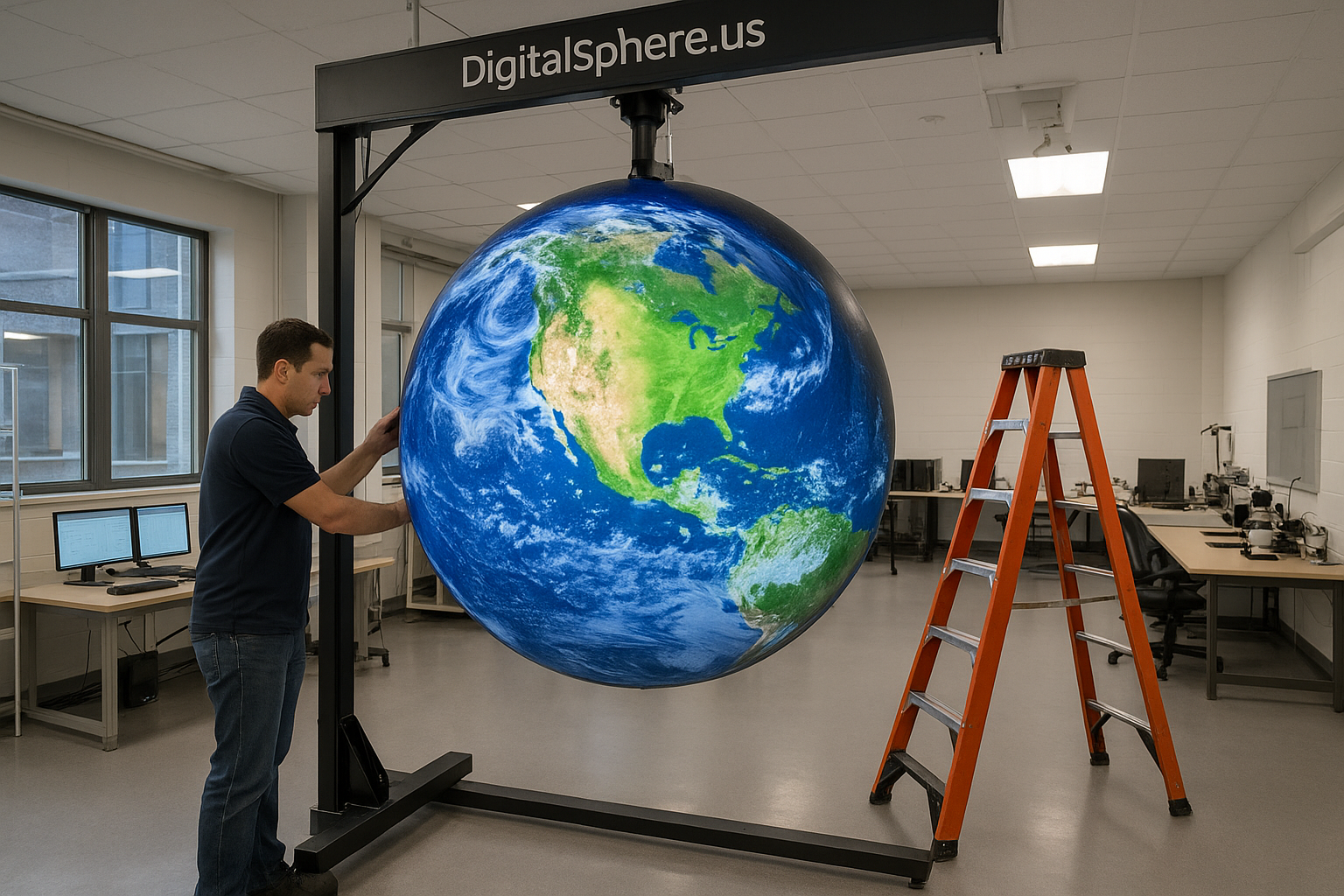
Unlocking Innovation: Digital Spheres for University Research
In today’s fast-paced academic environment, universities are constantly seeking new tools to empower researchers, inspire students, and communicate complex information effectively. Digital Spheres for University Research have emerged as groundbreaking instruments bridging technology, science, and education. These immersive spherical visualization displays, like those offered by DigitalSphere.us, are revolutionizing how universities visualize global datasets, conduct STEM research, and foster interactive learning environments.
Why Digital Spheres for University Research?
Traditional flat screens have long served their purpose for presentations and data review. However, digital spheres provide a truly immersive, 360-degree visualization experience that enables both students and researchers to interact with data sets, earth simulations, atmospheric phenomena, and more in an intuitive, captivating manner. This leap in display technology is transforming research labs, science centers, and classroom settings on campuses worldwide.
How Digital Spheres Enhance Academic Research
1. Next-Level Data Visualization
Complex data sets—such as climate models, astronomical simulations, and biological systems—can be challenging to understand when viewed on traditional screens. Digital spheres visualize these datasets on a global or multi-dimensional scale, allowing for spatial relationships and real-world phenomena to be explored holistically. For example, projecting climate change models onto a globe offers a visceral understanding of shifting weather patterns, making research findings more tangible and compelling.
2. Interactivity Fuels Discovery
Modern digital spheres support interactive touch, motion, and mobile controls, enabling users to rotate, zoom, and manipulate visualizations. This interactivity promotes experimentation and collaborative problem-solving, as multiple users can engage with the sphere simultaneously to analyze data from different perspectives. Such features make educational spheres ideal for group projects, presentations, and public outreach events.
3. Immersive Teaching Tools
Professors and lecturers can leverage digital spheres to enhance STEM education, making scientific principles come alive for students. Whether demonstrating earth sciences, astronomy, or advanced physics, these displays turn lessons into memorable experiences. Universities using DigitalSphere.us solutions report improved comprehension and engagement among students—especially in disciplines relying heavily on spatial and temporal understanding.
Popular Applications of Digital Spheres in Research Settings
Earth and Environmental Sciences
Universities leading in climate and earth sciences frequently adopt digital spheres to illustrate weather patterns, seismic events, and global geology. Real-time data feeds, such as satellite imagery and planetary movements, can be mapped onto the display for collaborative research and public demonstrations. When planning outreach activities or exhibitions, institutions often opt for rental spheres.
Astrophysics and Planetary Science
By projecting astronomical visuals onto digital or LED spheres, researchers gain new perspectives on planetary motion, lunar cycles, and even exoplanet discovery. Spherical displays simplify the interpretation of sky maps and celestial mechanics, making them invaluable for both advanced research and introductory astronomy courses.
Medical and Biological Sciences
In medical schools, spheres are used to model human anatomy, display virus and bacteria transmission patterns, and simulate molecular structures. The 360-degree format supports group exploration of complex biological processes, helping future healthcare professionals develop a deeper understanding of interconnected systems.
Advantages of Interactive and Educational Spheres in Universities
Engaging Educational Experiences
Immersive educational spheres are proven to increase retention and spark curiosity among students. Interactive sphere displays present information in a visually impactful manner that resonates with today’s learners. DigitalSphere.us offers fully customizable educational spheres for museums, STEM labs, and university classrooms, ensuring institutions get the exact solution suited to their curriculum needs.
Collaboration and Public Outreach
Universities often serve as centers for public science engagement. Spherical displays serve as powerful communication tools during open days, maker fairs, and community outreach programs. Researchers can visually communicate findings to non-experts using intuitive, globe-based graphics, making complex scientific information more accessible to all.
Flexible Integration and Scalability
From compact desktop spheres to large-format sphere displays, modern digital spheres are designed for seamless integration with existing IT infrastructure. Custom software enables effortless content updates, networked collaboration, and expansion as research needs grow. Custom solutions from DigitalSphere.us guarantee support for a wide range of academic requirements.
How DigitalSphere.us Empowers University Research
DigitalSphere.us specializes in tailor-made LED sphere and digital globe solutions for university laboratories, lecture halls, and research centers. Their expertise spans:
- Interactive display technology for real-time data manipulation
- Turnkey installation and support for educational institutions
- Rental and event-friendly digital spheres for temporary exhibitions
- Custom content development for science visualization
- Integration with global data feeds and research-specific datasets
Their systems are trusted by leading universities and museums nationwide—with accolades for both reliability and flexibility in immersive education.
Explore More Spherical Visualization Solutions
For institutions interested in exploring cutting-edge digital sphere technology, both DigitalSphere.us and leading partners like SSI Displays are at the forefront of the immersive visualization movement. SSI Displays’ expertise with display hardware complements DigitalSphere.us’s strength in custom software and integration, together providing unmatched solutions for higher education and research environments.
Frequently Asked Questions: Digital Spheres for University Research
- What types of research benefit most from digital spheres?
- Digital spheres are invaluable in earth sciences, astronomy, medical imaging, environmental science, and any field involving geographic, spatial, or big data visualization.
- Are digital spheres affordable for university departments?
- Cost-effective solutions, including rental spheres for events and modular sphere systems, make it feasible for both large and small departments to access this technology. DigitalSphere.us provides scalable pricing based on scope and needs.
- How can digital spheres be integrated with classroom technology?
- Integration is seamless—with HDMI, wireless controls, and content management systems—making it easy to add digital spheres alongside existing projection and AV setups.
- What level of technical support is available?
- DigitalSphere.us offers comprehensive support, from installation to faculty training and ongoing system updates, ensuring minimal downtime and maximum value for academic users.
Conclusion
Digital spheres for university research are reshaping how higher education institutions visualize, analyze, and share information. These interactive, immersive systems unlock new opportunities for discovery, engagement, and collaboration across all scientific disciplines. Whether seeking a permanent installation or a short-term rental sphere for a special event, universities can stay at the forefront of research innovation with DigitalSphere.us’s tailored solutions.
Take the Next Step with DigitalSphere.us
If you’re ready to elevate your academic research and STEM education with state-of-the-art digital spheres, contact DigitalSphere.us today for a personalized consultation. Empower your students, faculty, and the next generation of scientific leaders with immersive visualization technology built for the classrooms, labs, and research centers of tomorrow.
